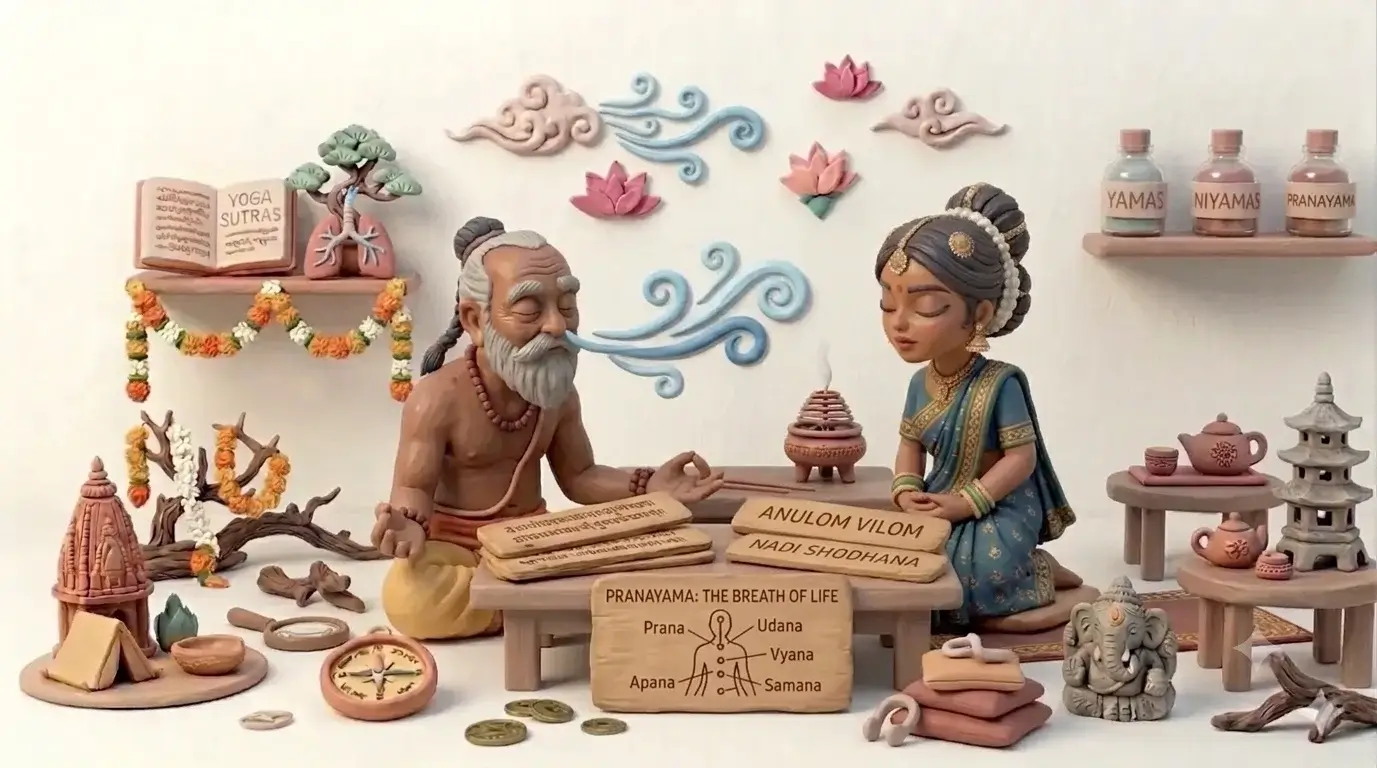
Prāṇāyāma: More Than Breathing
By David
·
May 19, 2026
·
11 min read
This is Part 4 of a series on the eight limbs of yoga. The first three explored the Yamas, the Niyamas, and Āsana: the ethical, the personal, and the physical foundations of the path. Now we arrive at the breath. You've been breathing your whole life, some twenty thousand times a day, without a single conscious thought, so it's tempting to assume the fourth limb has little left to teach. What could there possibly be to practise? Quite a lot, as it turns out. Prāṇāyāma is where yoga stops being something you do with your body and starts being something you do with your attention, and the breath is the doorway. This article unpacks what that really means, on the mat and far beyond it.
What Is Prāṇāyāma?
If you've ever sat in a class while a teacher guided "three deep breaths" and quietly wondered what the fuss was about, you've met the most common misunderstanding about the fourth limb. Most people assume prāṇāyāma is just breathing exercises. A warm-up. Something to get through before the real practice begins.
It isn't. Prāṇāyāma is the fourth of Patanjali's eight limbs of yoga, and it sits at a hinge point in the whole system.
Start with the word, because the word is where the disagreement lives, and the disagreement is the point. Prāṇa is the life force, the vital energy that breath carries, more than just the oxygen in the air. The second half splits two ways. Read it as prāṇa + yama and you get "restraint of the life force," the breath brought under control. Read it as prāṇa + āyāma and you get "extension of the life force," the breath given room to expand. Control or expansion. Both readings are old, both are defensible, and as we'll see, choosing which one to emphasise changes how safe the practice is.
Where does it sit in the eight limbs? Exactly between the outer and the inner. The first four limbs, the Yamas, Niyamas, Āsana, and prāṇāyāma, are bahiraṅga, the external practices you do in the world. The last three, concentration, meditation, and absorption, are antaraṅga, the internal ones. Prāṇāyāma is the bridge. It's the last thing you do facing outward before the practice turns in.
Patanjali makes this structural. His definition begins in Yoga Sutra 2.49 with two words, tasmin sati, "that being established." That refers back to Āsana. You earn the right to work with the breath by first finding a steady seat (Sutra 2.46, Sthira Sukham Āsanam, which we explored in the previous article). Only from stillness can you begin to regulate śvāsa and praśvāsa, the inhale and the exhale. A few sutras later (2.52–2.53), Patanjali names the payoff: the veil over the inner light grows thin, and the mind becomes fit for concentration. That's the bridge in one sentence. Breath first, then the inward journey.
The Hatha Yoga Pradipika puts the same idea more plainly: "When the breath wanders, the mind also wanders. But when the breath is still, the mind also becomes still" (Hatha Yoga Pradipika 2.2).
That's the wager of the whole limb. The breath is the one autonomic function you can also take conscious hold of, the single lever that reaches both the body and the mind. Most of us never touch it. Prāṇāyāma is learning to.
The Core Principle
If Āsana had its three-word formula in Sthira Sukham Āsanam, prāṇāyāma has its components. Every technique, however elaborate, is built from four moving parts: pūraka, the inhalation; rechaka, the exhalation; antara-kumbhaka, the pause after the inhale, holding the breath in; and bāhya-kumbhaka, the pause after the exhale, holding the breath out.
Patanjali describes these movements in Sutra 2.50 and adds the variables you can play with: deśa (where you direct the breath), kāla (how long each part lasts), and saṅkhyā (the count, the number of rounds). Regulate those, he says, and the breath becomes what the sutra calls dīrgha and sūkṣma, long and subtle. That's the actual goal, and it's worth pausing on. The aim of prāṇāyāma is not to breathe hard. It's to breathe so slowly and so smoothly that the breath almost disappears.
Which brings us back to the two readings of the word. Early Hatha yoga leaned on yama, control, with a heavy emphasis on kumbhaka, breath retention. Hold the breath, build the heat, force the issue. It's powerful, and for some bodies it's also risky. Most modern teachers, and the safest daily practice, lean instead on āyāma, extension. You're not throttling the breath. You're giving it space. The difference matters more than it sounds, because the body reads a forced, strangled breath as a threat, and a threatened nervous system is the opposite of what you're trying to cultivate.
B.K.S. Iyengar caught the right spirit perfectly: "The breath must be enticed or cajoled, like catching a horse in a field, not by chasing after it, but by standing still with an apple in one's hand" (Light on Life). Entice, don't chase. Hold that image. It's the single most useful instruction in the entire limb, and it's also, not coincidentally, Ahimsa applied to your own breath. Non-violence starts with not strangling yourself in the name of self-improvement.
What Happens in Your Body
You don't have to believe anything mystical for prāṇāyāma to work. The mechanism is, by now, reasonably well understood, and it runs through a single nerve.
The vagus nerve is the main highway of the parasympathetic nervous system, the "rest and digest" side of things. Here's the useful part: your breath has a direct line to it. When you exhale, the vagus nerve slows your heart slightly. When you inhale, it eases off and the heart speeds up a touch. That gentle oscillation, heart rate rising and falling with the breath, is called respiratory sinus arrhythmia, and a strong one is a sign of a responsive, well-regulated nervous system.
The practical takeaway is almost embarrassingly simple. Make your exhale longer than your inhale, and you tilt the whole system toward calm. A 1:2 ratio, say four counts in and eight counts out, is the classic teaching for a reason. Research suggests that slow, exhale-weighted breathing reliably raises heart rate variability, the beat-to-beat variation that tends to track resilience and recovery. You can feel this within a few breaths. You don't have to wait for a study to confirm it.
There's a particular pace where this effect peaks. Around six breaths per minute, the cardiovascular system seems to hit a kind of resonance, and heart rate variability reaches its maximum. The exact sweet spot varies a little from person to person, somewhere in the range of four and a half to six and a half breaths a minute, but six is the number to remember. Five seconds in, five seconds out. That's coherent breathing, and it's about as close as breathwork gets to a universal setting.
Then there's the physiological sigh, which you already do without knowing it. It's the shuddery double-inhale of a child who's been crying, or the involuntary deep breath you take before sleep. A short inhale, a second sip of air on top, then a long slow exhale. The second inhale re-inflates the tiny collapsed air sacs in your lungs; the long exhale offloads carbon dioxide. In a 2023 Stanford study published in Cell Reports Medicine, researchers had around 110 adults practise five minutes a day of one breathing technique for about a month. The cyclic sighing group, doing exactly this double-inhale, long-exhale pattern, came out ahead of both box breathing and mindfulness meditation for improving mood and lowering resting breathing rate. Five minutes a day. It's the best return on investment in the whole practice.
One more piece, lightly held: chronic over-breathing, the shallow, fast, upper-chest breathing that stress trains into us, can leave the body over-sensitive to carbon dioxide, which keeps the whole system jumpy. Slow, paced breathing gradually rebuilds your tolerance. The breath teaches the body it's safe to be calm.
On the Mat
Theory is cheap. Here are two techniques worth actually learning, with the cues I'd give in a room.
Nāḍī Shodhana (Alternate Nostril Breathing)
This is the one I reach for when a student's mind is racing. Nāḍī means channel, shodhana means cleansing. The traditional framing is that it balances the two main energy channels, iḍā (left, cooling) and piṅgalā (right, heating). You don't need to buy the subtle-body map for it to settle you. The simple act of slowing down and alternating sides is enough.
Sit tall. Rest your right thumb lightly beside your right nostril and your ring finger beside the left. Close the right, breathe in through the left. Close the left, release the right, breathe out. In through the right. Close it, breathe out through the left. That's one round. Keep it smooth, unforced, and for most people, no retention at all to begin with.
The cue I use: "Let the breath be quiet enough that you can barely hear it." If you're straining to fill or empty the lungs, you've gone too far. This is also where Satya, truthfulness, shows up, the honesty to work with today's lung capacity, not the count the person on the next mat is using.
Ujjāyī (Ocean Breath)
If Nāḍī Shodhana calms, Ujjāyī focuses. You make it by very gently narrowing the back of the throat, the same shape you'd use to fog a mirror, but with the mouth closed, so the breath takes on a soft oceanic sound. That sound is the whole point. It gives your attention something to hold, a thread to follow when the mind drifts.
Ujjāyī is the breath you ride through a moving Āsana practice. It's the steadiness inside the postures, the audible proof that you've found sthira and sukha in the breath itself: steady enough to keep the sound even, easy enough not to grip the throat. The cue: "Make the sound soft, like a whisper, not a growl." If your throat feels tight, you're forcing it. Back off.
Here's a rough map of the common techniques, sorted by what they do to your system:
| Technique | Effect | Reach for it when |
|---|---|---|
| Nāḍī Shodhana (alternate nostril) | Balancing | The mind won't stop spinning |
| Ujjāyī (ocean breath) | Gently focusing | You need an anchor for attention |
| Dīrgha (three-part breath) | Calming | Breathing has gone shallow and high |
| Bhrāmarī (humming bee) | Strongly calming | Winding down toward sleep |
| Kapālabhāti (skull-shining) | Activating | You need to wake up and sharpen |
| Bhastrikā (bellows) | Strongly activating | Lethargy needs shifting (use with care) |
The calming techniques are safe to explore on your own. The two activating ones at the bottom, the rapid, forceful practices, are exactly the ones that come with conditions attached. (Kapālabhāti, strictly speaking, is a cleansing kriya rather than a prāṇāyāma proper, though it's nearly always taught alongside the breath.) Which is the next thing to talk about.
A Genuine Word on Safety
Āsana didn't really need a safety warning. Prāṇāyāma does, and pretending otherwise would be its own kind of dishonesty. This is Ahimsa again, non-harm, made specific. Most breathing is gentle and safe for almost everyone. A few practices are not, and the difference is worth knowing before you teach them or try them.
Glaucoma or eye-pressure problems. Skip breath retention and any forceful or strained exhale. The internal pressure of a held or strained breath (a Valsalva manoeuvre) can raise pressure inside the eye. Slow, unforced breathing only.
Epilepsy, uncontrolled high blood pressure, or heart conditions. Avoid the vigorous, hyperventilating practices, Kapālabhāti and Bhastrikā, and avoid long breath holds. The rapid versions can tip the body's chemistry in ways that, for these conditions, carry real risk. Slow diaphragmatic breathing instead.
Pregnancy. Leave out forceful abdominal pumping and intense retention. Gentle three-part breathing and alternate-nostril without retention are welcome.
Anxiety and panic. This one surprises people. Rigid counts and held breaths can mimic the sensation of suffocation and tip a vulnerable nervous system straight into panic. For anyone prone to it, less is more: no retention, unforced exhalations, and permission to stop the instant the breath starts to feel like a struggle.
The principle underneath every line of that list is the one we already have. Entice, don't chase. If you're forcing the breath, you've already left the practice, whatever it looks like from the outside.
Off the Mat
This is where prāṇāyāma earns its place in daily life, because you don't need a mat, a cushion, or a spare hour. You need about a minute, and you can take it anywhere.
Before you teach, or before anything that makes you nervous, take one to three physiological sighs. Double inhale through the nose, long exhale through the mouth. It's the fastest way down off an adrenaline spike, and nobody in the room will notice you doing it.
In the middle of a hard conversation, breathe in for four and out for six, through the nose, while the other person is talking. The longer exhale keeps the calming side of your nervous system engaged, which keeps the thinking part of your brain online, which is the difference between responding and reacting. This is Satya bought with breath: it buys you the half-second you need to say the true thing instead of the sharp thing.
When you can't fall asleep, try Bhrāmarī, the humming breath. Inhale normally, then hum on a long exhale, low and soft, so you feel the vibration in your face. Six to eight rounds. The hum extends the exhale and adds a soothing vibration that's hard to overthink your way past.
Before a block of focused work, do coherent breathing, five seconds in and five seconds out, for five to ten minutes. It's the admin equivalent of tuning an instrument before you play. The studio inbox will still be there. You'll just meet it from a steadier place.
None of these are exotic. That's the point. The breath you already own is a regulation tool you carry everywhere, and the only thing standing between you and it is remembering it's there. Which, honestly, is most of the practice.
Where the Limbs Meet
By now the pattern of this series should be familiar: no limb stands alone. Prāṇāyāma is woven through all of them.
It rests directly on Āsana. You can't steady the breath in a body that can't sit still, which is exactly what Patanjali's tasmin sati, "that being established," insists on. And the deeper inheritance is sthira and sukha, the steadiness and ease we explored in the last article. The breath wants both: steady enough to hold a rhythm, easy enough never to strain. The breath, it turns out, was the thread running through every posture all along.
It needs the Yamas. Ahimsa is the whole safety conversation in a single word, never force. Satya is the honesty to breathe at your real capacity rather than perform someone else's.
It draws on the Niyamas. Tapas, disciplined practice, is what turns five minutes a day into something that actually changes you, because prāṇāyāma rewards consistency over intensity more than almost any practice in yoga. And Śauca, purification, finds a literal expression here: every long exhale is a small clearing-out, the oldest meaning of cleansing applied to the breath.
And it points forward, to the limbs that turn inward. Steady the breath and the mind grows quiet enough to begin withdrawing the senses, which is where this series goes next.
Five Questions Worth Sitting With
Not quick-answer questions. Pick one, carry it for a week, and see what surfaces.
Where in my day does my breath go shallow and high in my chest, and what's happening when it does?
When I'm stressed, do I hold my breath without noticing?
Can I make my exhale longer than my inhale for ten breaths, without any strain at all?
What would change if I took three slow breaths before responding, instead of three sharp ones after reacting?
Am I chasing the breath, or enticing it?
The Practice Is the Point
Prāṇāyāma isn't a warm-up for the real yoga. It is the real yoga, the moment the practice stops being something you perform with your body and becomes something you steer with your attention. The breath is the only door in the whole system that opens both ways, into the body and into the mind, and learning to move through it slowly is most of what the fourth limb asks.
As B.K.S. Iyengar wrote, "prāṇāyāma is a bridge which helps the student of yoga to cross from the realm of purely physical development to that of the spirit" (Light on Prāṇāyāma). The breath is how you cross.
You'll forget it constantly. You'll catch yourself holding your breath over a difficult email, breathing high and fast through a stressful afternoon, racing the clock between classes with your shoulders up around your ears. And then, one day, you'll notice. You'll take a long exhale before you reply. You'll find your seat, find your breath, and let it slow. And noticing, as with the Yamas and Niyamas and Āsana before it, is the entire practice.
Next in this series, we'll explore the fifth limb: Pratyāhāra, the withdrawal of the senses. If āsana taught you to find your seat in the body, and prāṇāyāma taught you to find your rhythm in the breath, pratyāhāra is where you learn to turn the attention inward, away from the constant pull of the outside world. It's the threshold of the inner practice, and the breath is what carries you across it.
Frequently Asked Questions
What is Prāṇāyāma in simple terms?
Prāṇāyāma is the fourth of the eight limbs of yoga, the conscious regulation of the breath. The word combines prāṇa (life force or vital energy) with either yama (restraint) or āyāma (extension), so it means both controlling and expanding the breath. In practice, it's a set of techniques, from slow alternate-nostril breathing to a simple long exhale, that use the breath to steady the nervous system and prepare the mind for concentration. It sits between the outward and inward limbs of yoga as a bridge.
Does pranayama actually do anything, or is it just relaxation?
There's a real physiological mechanism behind it. Slow breathing, especially when the exhale is longer than the inhale, stimulates the vagus nerve and shifts you toward the parasympathetic rest-and-digest state, which research suggests raises heart rate variability, a marker of nervous-system resilience. Breathing at around six breaths per minute appears to maximise this effect. One 2023 Stanford study, published in Cell Reports Medicine, found that five minutes a day of cyclic sighing improved mood and lowered resting breathing rate more than mindfulness meditation did. So it's relaxation, but with a measurable basis.
Is pranayama safe for everyone?
Gentle breathing is safe for almost everyone, but some techniques carry genuine cautions. People with glaucoma should avoid breath retention and forceful exhalations, which can raise eye pressure. Those with epilepsy, uncontrolled high blood pressure, or heart conditions should avoid the rapid, forceful practices (Kapālabhāti and Bhastrikā) and long breath holds. During pregnancy, skip forceful abdominal techniques and intense retention. Anyone prone to anxiety or panic should avoid rigid counts and breath-holding, which can mimic suffocation. The guiding principle is never to force the breath.
Which breathing technique should I start with?
For calming a busy mind, alternate-nostril breathing (Nāḍī Shodhana) without any retention is a gentle, reliable place to begin. For everyday regulation, coherent breathing, five seconds in and five seconds out, takes no instruction at all and works almost anywhere. And the physiological sigh, a double inhale followed by a long exhale, is the fastest way to settle in a stressful moment. All three are safe to explore on your own, unlike the more vigorous practices.
How does pranayama connect to the rest of yoga?
Prāṇāyāma is the bridge between the outer limbs (the Yamas, Niyamas, and Āsana) and the inner ones (concentration, meditation, and absorption). It rests on Āsana, since you need a steady seat before you can steady the breath, and it carries forward the principle of sthira sukham, steadiness and ease. It depends on the Yamas, especially Ahimsa (never forcing) and Satya (honest capacity), and on the Niyamas, especially Tapas (consistent practice). Calming the breath is what prepares the mind for the inward limbs that follow.
Related Articles
Āsana: More Than a Pose
This is Part 3 of a series on the eight limbs of yoga. Parts 1 and 2 explored the Yamas and Niyamas, the ethical and personal foundations of the yogic path. Now we arrive at the limb most people think they already know: Āsana. Walk into any yoga studio and you'll see it, bodies moving through postures, holding shapes, stretching and strengthening. But Patanjali's definition of Āsana had almost nothing to do with what happens in a modern yoga class. His entire instruction for the physical practice fits into three Sanskrit words: Sthira Sukham Āsanam. Steady. Comfortable. That's it. This article unpacks what that really means, on the mat and far beyond it.
10 min read
·
Mar 31, 2026
The 5 Niyamas in Daily Life
This is Part 2 of a series on the eight limbs of yoga. In Part 1, we explored the five Yamas, the ethical principles that shape how you relate to the world around you. The Niyamas turn that lens inward. They're the second limb of Patanjali's eight-limbed path, and they deal with how you relate to yourself: your habits, your discipline, your inner dialogue, and your willingness to let go. If the Yamas are about how you show up for others, the Niyamas are about how you show up for yourself, especially when nobody's watching.
10 min read
·
Mar 22, 2026

The 5 Yamas in Daily Life
Most yoga teacher trainings cover the Yamas in a weekend afternoon. You learn the Sanskrit names, scribble a few notes, and move on to sequencing. But these five ethical principles from Patanjali's Yoga Sutras weren't designed for a notebook. They were designed for the messy, real-world situations that make you uncomfortable, the ones that show up at your studio, in your relationships, and in the quiet moments when nobody's watching. This is Part 1 of a series on the eight limbs of yoga. Here, we unpack the five Yamas. Part 2 will cover the five Niyamas.
10 min read
·
Mar 11, 2026