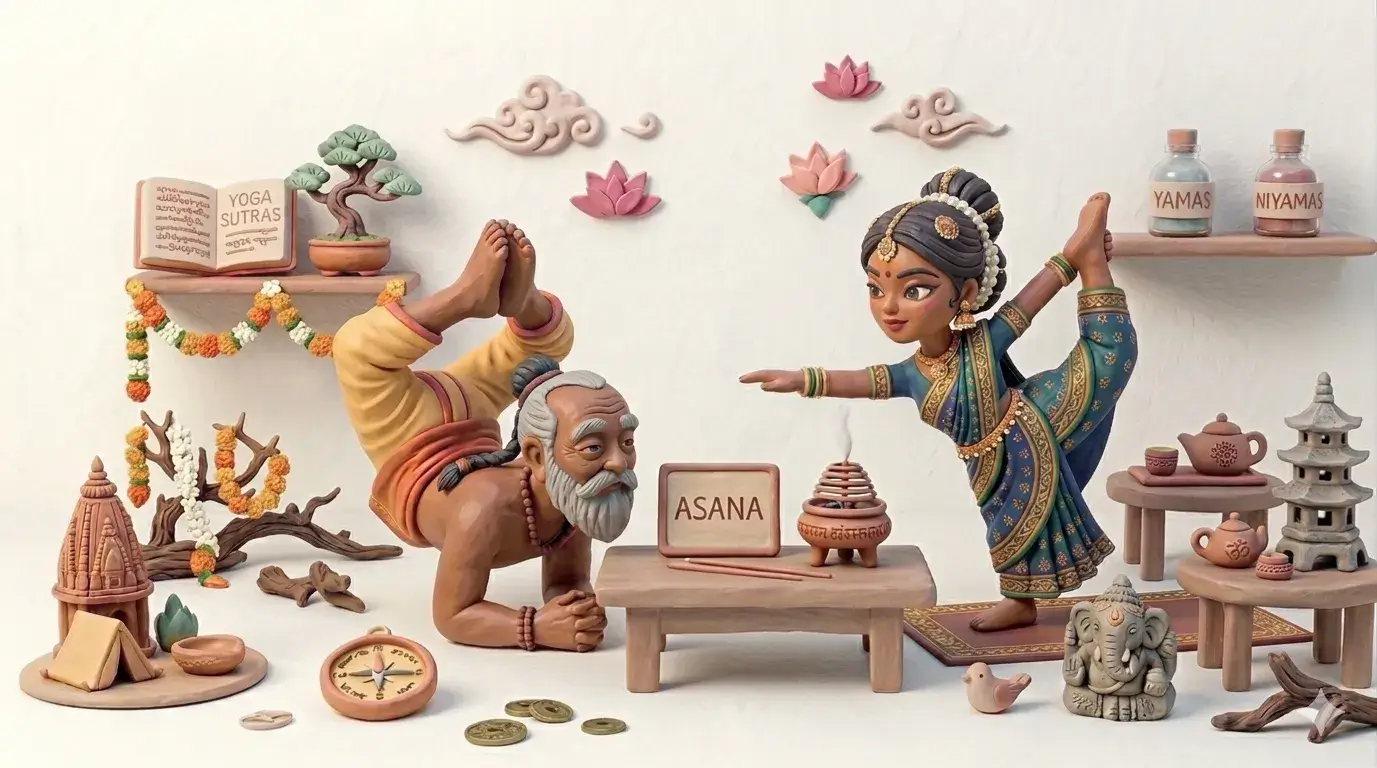
Āsana: More Than a Pose
By David
·
March 31, 2026
·
10 min read
This is Part 3 of a series on the eight limbs of yoga. Parts 1 and 2 explored the Yamas and Niyamas, the ethical and personal foundations of the yogic path. Now we arrive at the limb most people think they already know: Āsana. Walk into any yoga studio and you'll see it, bodies moving through postures, holding shapes, stretching and strengthening. But Patanjali's definition of Āsana had almost nothing to do with what happens in a modern yoga class. His entire instruction for the physical practice fits into three Sanskrit words: Sthira Sukham Āsanam. Steady. Comfortable. That's it. This article unpacks what that really means, on the mat and far beyond it.
What Is Āsana?
If you've ever told someone you practise yoga and they immediately pictured a handstand on a beach, you've encountered the most widespread misconception in the yoga world. For most people, yoga and āsana are the same thing. They're not.
Āsana is the third of Patanjali's eight limbs of yoga. The word comes from the Sanskrit root "as," which means to sit or to be established in a position. In its original context, āsana simply meant a seat, specifically the seated posture a practitioner held during meditation. Not a flow sequence. Not a peak pose. A seat.
B.K.S. Iyengar used the metaphor of a tree to describe the eight limbs, and it's a useful one for understanding where āsana fits. The Yamas are the roots, the ethical foundation that grounds everything. The Niyamas are the trunk, the personal disciplines that create a strong inner structure. Āsana is the branches, extending outward and upward, strong enough to hold their shape yet flexible enough to bend with the wind. Branches that grow from shallow roots and a weak trunk don't last. The same is true for a physical practice built without ethical grounding and personal discipline.
The evolution of āsana from a single meditative seat to the thousands of postures taught today is a relatively modern development. Early texts like the Hatha Yoga Pradipika describe only a handful of positions, and Patanjali himself dedicated just three sutras to the entire physical practice. The explosion of postural yoga happened largely in the twentieth century, shaped by Indian gymnastics traditions, Western fitness culture, and the global market's appetite for something visible and marketable. None of that is inherently bad. But it helps to know that when you teach a 60-minute vinyasa class with 40 transitions, you're operating in a tradition that is roughly a century old, not several millennia.
Understanding this context doesn't diminish the physical practice. It places it honestly within the larger framework. Āsana matters. It just isn't the whole story.
Sthira Sukham Āsanam
Patanjali's entire instruction for the physical practice is contained in Yoga Sutra 2.46: Sthira Sukham Āsanam. Three words. Roughly translated: the posture should be steady and comfortable.
That's the complete set of physical instructions from the person who codified the entire yogic path. No alignment cues, no sequencing principles, no peak poses. Just two qualities that every posture, and arguably every moment of your life, should express. Understanding what those two qualities actually mean is where the real work begins.
Sthira: The Art of Steadiness
Sthira comes from the Sanskrit root "stha," meaning to stand or to be firm. It encompasses stability, strength, alertness, and focused intention. On a physical level, sthira is the engagement required to hold a posture: the grounding of your feet into the floor, the activation of your core, the quiet strength of muscles doing their job without drama.
But the physical dimension is only half of it. Sthira also describes a quality of mind. A calm, focused attention that doesn't collapse when things get difficult. The mental steadiness to stay present through the tenth breath of a challenging hold, when every part of your brain is offering you excellent reasons to come out early.
Without sthira, a posture loses its structure. The body sags. The mind wanders. The practice becomes shapeless. For teachers, sthira is also the discipline of showing up consistently, of maintaining the quality of your teaching on a Thursday evening when the room is half empty, not just on a packed Saturday morning.
Sukha: The Art of Ease
Sukha is where most practitioners, especially driven ones, struggle. The word is typically translated as ease or comfort, but its etymology reveals something richer. "Su" means good, and "kha" means space. The literal meaning is "good space," an image borrowed from the well-fitted axle hole of a chariot wheel. When the axle sits perfectly in the hub, the ride is smooth. When it doesn't, everything grinds. It's worth noting that the opposite of sukha is duhkha, literally "bad space" or a poorly fitted axle, the Sanskrit word for suffering. The entire spectrum from ease to suffering lives inside this one mechanical image.
In āsana, sukha is the ability to find space within effort. The softened jaw while the legs are working in Warrior II. The relaxed shoulders in a long plank hold. The steady breath that continues flowing even as the body encounters its edges. Sukha is not the absence of effort. It's the presence of ease within effort.
Mentally, sukha manifests as a quality of openness. It's the self-compassion to use a block when your hamstrings say no. It's the contentment to work with today's body instead of mourning yesterday's flexibility. If you recognise the Niyama Santosha here, you should. The limbs don't live in isolation. They show up inside each other constantly.
Finding the Balance
The ideal āsana exists in the space between these two qualities. Patanjali's next sutra (2.47) offers a clue to how: through the relaxation of effort and absorption in the infinite. In practice, that means letting go of the struggle within a pose while expanding your awareness beyond the body's edges. T.K.V. Desikachar put it more simply: "attention without tension; loosening up without slackness." Too much sthira and you're rigid, white-knuckling your way through a practice that looks impressive but feels like punishment. Too much sukha and there's no structure, no engagement, no growth.
The balance point isn't static. It shifts from day to day, pose to pose, breath to breath. In a deep backbend, sthira might need to dominate. In a restorative forward fold, sukha leads. The practice is learning to feel where the dial needs to be in any given moment, and being honest enough with yourself to adjust it.
| Sthira (Steadiness) | Sukha (Ease) | |
|---|---|---|
| Physical | Strength, grounding, alignment | Relaxation, breath, softness |
| Mental | Focus, discipline, presence | Contentment, openness, self-compassion |
| When excessive | Rigidity, tension, strain | Collapse, distraction, lethargy |
| Desikachar's words | "Attention without tension" | "Loosening up without slackness" |
What Happens in Your Body
Modern research is catching up with what practitioners have observed for centuries: āsana does something to the nervous system that goes well beyond flexibility and strength.
When you practise a challenging posture with steadiness (sthira), you activate the sympathetic nervous system, the part responsible for alertness, energy, and mobilisation. When you then soften into ease (sukha), particularly through slow exhalation, you shift toward the parasympathetic response, the body's rest-and-repair mode.
A well-constructed yoga practice trains you to move between these two states deliberately. This is fundamentally different from a gym workout, which tends to push the sympathetic system hard and leave the cool-down as an afterthought. In āsana, the transition between effort and ease isn't the postscript. It's the entire point.
This matters beyond fitness. Chronic stress keeps the sympathetic system running long after the perceived threat has passed. Over time, the body loses the ability to shift back to rest efficiently. Āsana, practised according to the principle of sthira sukham, retrains that capacity. Poses like Legs-Up-The-Wall or Supported Child's Pose aren't "easy" alternatives to "real" yoga. They're direct interventions for a dysregulated nervous system. For students dealing with back pain, tension headaches, or the physical residue of prolonged sitting, these restorative postures can be more therapeutic than any power flow.
There's also the dimension of interoception, your ability to sense what's happening inside your own body. Āsana builds this internal literacy in a way that few other physical practices do, precisely because it asks you to pay attention to sensations rather than override them. When a pose starts to feel unsafe or your breath becomes ragged, sthira sukham says back off. That boundary isn't a limitation. It's Ahimsa, non-violence toward yourself, practised in real time.
Psychologists call this working within the "Window of Tolerance," the zone where you feel challenged but not overwhelmed. Āsana trains you to find that window, stay in it, and gradually expand it. For students recovering from injury, chronic pain, or trauma, this interoceptive awareness is often more valuable than any increase in range of motion. Learning to trust your body's signals, after months or years of either ignoring or being overwhelmed by them, is a quiet revolution. And it starts with the simplest instruction in all of yoga: be steady. Be comfortable.
On the Mat
Theory only goes so far. Here's what sthira sukham actually looks and feels like in two common postures.
Warrior II (Virabhadrasana II)
Warrior II is a posture that reveals your relationship to effort almost immediately. The sthira is in the bent front knee tracking over the ankle, the back leg engaged, the arms reaching actively. The sukha is in the shoulders dropping away from the ears, the face relaxing, the breath staying slow and even despite the fire building in the front thigh.
Most practitioners default to one extreme. The effort-driven student locks the jaw, tenses the hands, and turns the whole thing into a battle of will. The ease-seeking student lets the front knee drift inward, the arms droop, and waits for it to be over. The practice is finding the middle ground: strong enough to hold the shape, soft enough to breathe and observe from within it.
A useful teaching cue: "Can you find one place in this pose where you're working harder than you need to, and let it go without losing the shape?"
Tree Pose (Vrksasana)
Tree Pose is a laboratory for sthira sukham on a smaller, more honest scale. There's nowhere to hide in a balance pose. The sthira is in the standing leg pressing firmly into the ground, the core quietly engaged, the gaze fixed. The sukha is in the standing foot staying relaxed rather than gripping, the hip of the lifted leg opening without force, and the willingness to wobble without treating it as failure.
Because here's the thing most beginners don't hear enough: the wobble is the practice. A tree doesn't resist the wind. It absorbs it, sways, and returns to centre. Every micro-adjustment your ankle makes in Tree Pose is your nervous system learning how to find balance in real time. If the pose were perfectly still, it wouldn't be teaching you much.
This is also where āsana meets the Yama Satya, truthfulness. Being honest about which variation serves you today. Foot on the calf instead of the thigh. Hand on a wall instead of overhead. Satya says the truest version of the pose is the one that lets you practise both steadiness and ease without pretending your body is somewhere it isn't.
Off the Mat
If sthira sukham only applied to postures, Patanjali wouldn't have needed to write it down. The real yield of the practice is what happens when you take these two principles into the rest of your life.
The Posture of Your Work
Most yoga teachers and studio owners spend more time sitting at a desk than they'd like to admit. Responding to emails, managing schedules, updating the website. The principles of āsana apply directly to how you sit while doing it.
Sthira in the workplace means grounding your feet flat on the floor, sitting with a spine that's tall but not forced, creating a physical foundation that supports sustained attention. Sukha means letting the shoulders drop, relaxing the hands between typing bursts, and taking brief pauses to check in with your body rather than powering through a three-hour admin session without moving.
This isn't just ergonomic advice dressed up in Sanskrit. The way you hold your body shapes the way you think. A collapsed posture produces collapsed energy. A rigid posture produces rigid thinking. The "good space" of sukha, applied to your work setup, creates conditions where you can be productive without burning out by Tuesday.
Relationships
Every relationship requires the same negotiation between strength and flexibility that a yoga posture does. Sthira in relationships looks like boundaries, clear communication, and a stable sense of who you are that doesn't shift based on the other person's mood. Sukha looks like the ability to listen without planning your response, to change your mind when presented with new information, and to let small things go without keeping score.
The couples who only practise sthira become rigid. They dig into positions, hold grudges, and turn disagreements into battles of principle. The ones who only practise sukha lose themselves. They accommodate, avoid conflict, and wonder why they feel resentful.
The healthy relationship, like the healthy posture, is steady enough to hold its shape and soft enough to move with what life brings. And just like on the mat, the balance point shifts. Some conversations need more firmness. Some need more give. The skill is knowing which one this moment requires.
Emotional Resilience
The Bhagavad Gita describes the ideal state of mind as "steady like a lamp in a windless place." That's sthira applied to the inner world. But life is rarely windless, which is where sukha becomes essential.
Emotional resilience isn't the ability to feel nothing. It's the ability to feel what's happening without being consumed by it, to be shaken without being toppled. Every time you hold a challenging pose and choose to breathe rather than clench, you're rehearsing this skill in miniature. The body learns it first. The emotions follow.
When a difficult email lands in your inbox, you have a choice. The sthira response is to stay grounded, to read it carefully, to resist the urge to fire back in the first sixty seconds. The sukha response is to soften around the tension it creates, to notice the tightness in your chest without adding a story to it, to give yourself space before you respond. Neither quality alone is sufficient. Together, they're what keeps you from sending the email you'd regret.
Rituals and Stillness
There's a version of āsana that has nothing to do with physical postures at all, and it might be the most important one. It's the practice of simply stopping, sitting down, and paying attention to what's happening inside you. No mat, no sequence, no teacher. Just a seat.
This is what āsana meant before it meant anything else. A seat for observation. A place where you stop performing your life and start noticing it. In a culture that treats busyness as a personality trait, the most radical āsana you can practise might be sitting still for ten minutes with nothing to achieve.
Sometimes the most useful thing you can do between classes, between meetings, between whatever comes next, is to find your seat. Not to fix anything. Just to notice what's already there.
Where the Limbs Meet
The eight limbs are not a staircase where you complete one and move to the next. They're more like instruments in an ensemble. Each one sounds different alone, but the real music happens when they play together.
You can't practise āsana honestly without practising the Yamas. Ahimsa (non-violence) is what tells you to stop before injury, to modify without shame, to treat your body as an ally rather than an obstacle. Without Ahimsa, āsana becomes a contest with yourself, and the only possible outcome is harm.
Satya (truthfulness) keeps your practice honest. It's the difference between working at your edge and pretending you're somewhere you're not. The student who forces a bind they can't safely hold isn't practising āsana. They're practising self-deception in a yoga-shaped container.
From the Niyamas, Tapas (discipline) provides the heat that makes āsana transformative. It's what keeps you practising on the days when nothing feels inspiring, when the body is stiff, when the mind says "not today." Tapas isn't about pushing through pain. It's about showing up through resistance. There's a difference.
And Santosha (contentment) is what prevents āsana from becoming an endless pursuit of the next pose, the deeper bend, the longer hold. Santosha says: this body, in this posture, with this breath, right now, is enough. You can work toward more while being at peace with where you are. That's not contradiction. That's maturity.
Five Questions Worth Sitting With
These aren't quick-answer questions. They're invitations to notice. Pick one, sit with it for a week, and see what surfaces.
Where in my life am I applying so much effort that there's no room left for ease?
Where am I so comfortable that I've stopped growing?
When I encounter discomfort, is my first impulse to push harder or to collapse? What would it look like to do neither?
Can I identify a relationship, a habit, or a commitment that needs more steadiness? One that needs more softness?
What would change if I treated my daily routines, not just my yoga practice, as a form of āsana?
The Practice Is the Point
Āsana, in its truest sense, isn't a shape you make with your body. It's a state you cultivate with your attention. Sthira sukham, steadiness and ease, is as relevant in how you sit at your desk as in how you hold Warrior II. It shows up in how you navigate a difficult conversation, how you respond to uncertainty, and how you treat yourself on the days when nothing feels balanced.
The physical practice is a laboratory. The mat is where you learn to notice the pull toward extremes, too much effort or too little, too much rigidity or too much give, and to find the point between them where something alive and sustainable lives. But the laboratory is only valuable if you take the findings with you when you leave.
If the Yamas taught you how to be in relationship with the world, and the Niyamas taught you how to be in relationship with yourself, āsana teaches you how to be in relationship with your body and, through that body, with the present moment. It's the limb where philosophy becomes physical. Where the abstract principles of the first two limbs land in muscle, breath, and bone.
You'll lose the balance. Constantly. You'll find sthira and forget sukha. You'll dissolve into ease and lose your structure. You'll push too hard on Monday and compensate by not showing up on Wednesday. And then you'll notice. And noticing, as with the Yamas and Niyamas before it, is the entire practice.
Next in this series, we'll explore the fourth limb: Pranayama. If āsana is the practice of finding your seat in the body, pranayama is the practice of finding your rhythm in the breath. It's where the physical gives way to the subtle, and where the real inward journey begins.
Frequently Asked Questions
What does Āsana really mean in yoga?
Āsana comes from the Sanskrit root 'as,' meaning to sit or to be established in a position. In Patanjali's Yoga Sutras, it referred specifically to a steady, comfortable seat for meditation, not the thousands of physical postures we associate with modern yoga. The full instruction is contained in Sutra 2.46: Sthira Sukham Āsanam, meaning the posture should embody both steadiness (sthira) and ease (sukha). The vast repertoire of poses practised today evolved largely in the twentieth century.
What is the difference between Sthira and Sukha?
Sthira means steadiness, strength, and focused attention. It's the effort and engagement required to hold a posture and maintain mental presence. Sukha means ease, comfort, and 'good space,' originally referring to a well-fitted axle hole in a chariot wheel that allows a smooth ride. In practice, sthira is the fire and sukha is the water. A posture (or a life) with only sthira becomes rigid and tense. One with only sukha becomes shapeless and directionless. The practice is finding the balance between them, which shifts from moment to moment.
Can you practise Āsana principles without doing yoga poses?
Yes. Sthira sukham, the core principle of āsana, applies anywhere you hold a position or navigate effort and ease. Sitting at a desk with grounded feet and relaxed shoulders is āsana. Maintaining boundaries in a relationship while staying open to the other person's perspective is āsana. Staying emotionally steady during a difficult conversation without shutting down is āsana. The physical postures are a training ground, but the principles extend into every part of daily life.
How does Āsana connect to the Yamas and Niyamas?
The eight limbs of yoga work together, not as a sequence you complete one at a time. Āsana practised without Ahimsa (non-violence) becomes self-harm through overexertion. Without Satya (truthfulness), it becomes performative rather than honest. Tapas (discipline) provides the commitment to keep practising through resistance, while Santosha (contentment) prevents the practice from becoming an anxious pursuit of perfection. The physical postures are where the ethical and personal principles of the first two limbs become tangible and embodied.
Is yoga just physical exercise?
No. The physical postures (āsana) are one of eight limbs in Patanjali's yogic path. The first two limbs, the Yamas and Niyamas, address ethics and personal discipline. The limbs that follow āsana, including Pranayama (breathwork), Pratyahara (sense withdrawal), Dharana (concentration), Dhyana (meditation), and Samadhi (absorption), move progressively inward. The modern focus on physical postures reflects twentieth-century market preferences, not the tradition's original emphasis. Āsana is valuable, but it was always designed as preparation for the deeper, contemplative practices that follow.
Related Articles
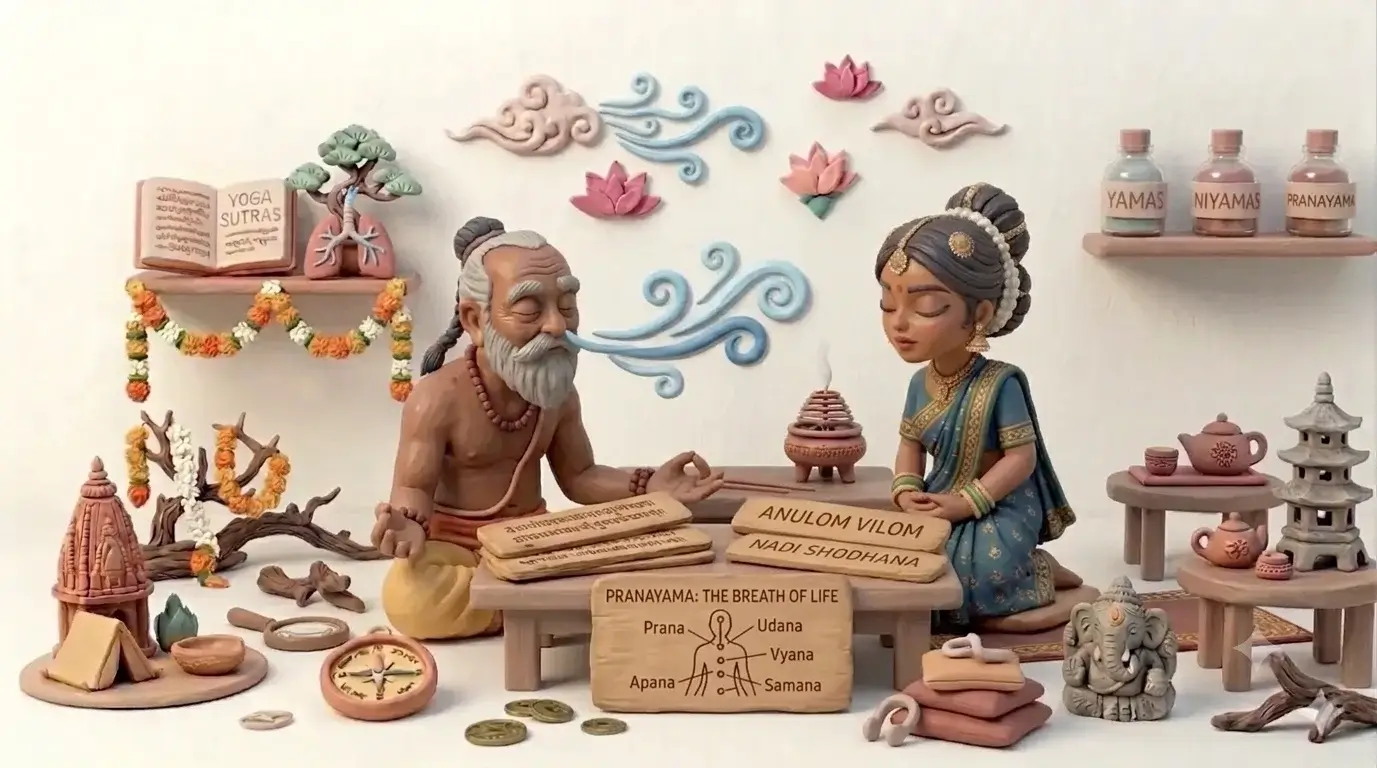
Prāṇāyāma: More Than Breathing
This is Part 4 of a series on the eight limbs of yoga. The first three explored the Yamas, the Niyamas, and Āsana: the ethical, the personal, and the physical foundations of the path. Now we arrive at the breath. You've been breathing your whole life, some twenty thousand times a day, without a single conscious thought, so it's tempting to assume the fourth limb has little left to teach. What could there possibly be to practise? Quite a lot, as it turns out. Prāṇāyāma is where yoga stops being something you do with your body and starts being something you do with your attention, and the breath is the doorway. This article unpacks what that really means, on the mat and far beyond it.
11 min read
·
May 19, 2026

The 5 Niyamas in Daily Life
This is Part 2 of a series on the eight limbs of yoga. In Part 1, we explored the five Yamas, the ethical principles that shape how you relate to the world around you. The Niyamas turn that lens inward. They're the second limb of Patanjali's eight-limbed path, and they deal with how you relate to yourself: your habits, your discipline, your inner dialogue, and your willingness to let go. If the Yamas are about how you show up for others, the Niyamas are about how you show up for yourself, especially when nobody's watching.
10 min read
·
Mar 22, 2026

The 5 Yamas in Daily Life
Most yoga teacher trainings cover the Yamas in a weekend afternoon. You learn the Sanskrit names, scribble a few notes, and move on to sequencing. But these five ethical principles from Patanjali's Yoga Sutras weren't designed for a notebook. They were designed for the messy, real-world situations that make you uncomfortable, the ones that show up at your studio, in your relationships, and in the quiet moments when nobody's watching. This is Part 1 of a series on the eight limbs of yoga. Here, we unpack the five Yamas. Part 2 will cover the five Niyamas.
10 min read
·
Mar 11, 2026