
The 5 Yamas in Daily Life
By David
·
March 11, 2026
·
10 min read
Most yoga teacher trainings cover the Yamas in a weekend afternoon. You learn the Sanskrit names, scribble a few notes, and move on to sequencing. But these five ethical principles from Patanjali's Yoga Sutras weren't designed for a notebook. They were designed for the messy, real-world situations that make you uncomfortable, the ones that show up at your studio, in your relationships, and in the quiet moments when nobody's watching. This is Part 1 of a series on the eight limbs of yoga. Here, we unpack the five Yamas. Part 2 will cover the five Niyamas.
What Are the Yamas?
The Yamas are the first of the eight limbs of yoga outlined in Patanjali's Yoga Sutras. They're often translated as "restraints" or "ethical disciplines," but that framing can feel heavy and rule-based. A more useful translation might be "how to be in relationship with everything outside yourself." The five Yamas — Ahimsa, Satya, Asteya, Brahmacharya, and Aparigraha, form a foundation for every other limb of yoga. Without them, the postures, breathwork, and meditation are just technique without character.
If you read our abundance consciousness checklist, you've already seen a few of these Yamas in action. Ahimsa showed up in the way you speak to colleagues. Asteya appeared in how you give credit. Aparigraha surfaced in how you approach pricing and competition. This article goes deeper into each one, and introduces Satya and Brahmacharya, two Yamas that rarely get the attention they deserve.
Ahimsa: Non-Harm
Ahimsa is usually the first Yama people learn, and for good reason. It's the broadest. Non-violence in the obvious sense, don't hurt people, is the floor, not the ceiling. The real practice begins with the subtler forms: the sharp comment to a student who arrived late, the internal monologue that tears apart your own teaching after a flat class, the passive-aggressive email to a colleague who dropped the ball.
On the Mat
As a teacher, Ahimsa shapes how you cue. "Push through the pain" is a scarcity-era instruction that has no place in a modern yoga class. Ahimsa asks you to offer modifications without making them feel like consolation prizes. It asks you to read the room, to notice when a student is grimacing through a bind they're not ready for, and to create an environment where backing off feels like wisdom, not weakness.
It also applies to yourself. If you're teaching six classes a day and skipping your own practice because you're exhausted, that's a form of self-harm dressed up as work ethic. Ahimsa starts at home.
Off the Mat
In the studio business, Ahimsa shows up in how you handle conflict. When a student leaves a negative review, your first draft of a response will probably fail the Ahimsa test. That's fine. Write it, delete it, and then write the one that acknowledges their experience without being defensive. When a teacher on your team underperforms, Ahimsa doesn't mean avoiding the conversation. It means having it honestly, without cruelty.
In your personal life, pay attention to the harm that lives in your assumptions. The snap judgement about the new teacher's sequencing. The uncharitable interpretation of a friend's cancelled plans. Ahimsa asks you to extend the same generosity to others that you'd want for yourself on a bad day.
Satya: Truthfulness
Satya is the Yama that makes people uncomfortable, because it asks you to be honest even when honesty is inconvenient. Not brutal honesty. That's usually just brutality with a label. Satya is honest in a way that serves clarity and connection, not ego.
On the Mat
Truthfulness in teaching means not pretending to know more than you do. If a student asks about a condition you haven't studied, Satya says "I don't know, but let me find out" rather than improvising an answer that sounds authoritative. It means being honest about the limitations of yoga. Yoga can do a great deal. It cannot replace physiotherapy, psychotherapy, or medical treatment. Teachers who blur those lines aren't being generous. They're being untruthful.
Satya also applies to how you present yourself. If your bio says "20 years of experience" but 15 of those were casual home practice, that's a stretch. Students trust you based on how you represent yourself. Honour that trust.
Off the Mat
In business, Satya is the antidote to performative marketing. It means your class descriptions match what actually happens in the room. It means your pricing is transparent, not buried behind a "contact us" button. It means when a student asks whether your membership is worth it for someone who can only come once a week, you give them an honest answer, even if that answer doesn't maximise revenue.
In personal relationships, Satya often collides with the desire to keep the peace. Telling a colleague their workshop concept needs more work feels risky. But a kind truth delivered early prevents a painful truth delivered too late. The practice isn't saying everything you think. It's not hiding what matters.
Asteya: Non-Stealing
Asteya goes far beyond not taking physical objects that don't belong to you. In the yoga world, the most common forms of stealing are invisible: stealing time, stealing credit, stealing attention.
On the Mat
Stealing time is the teacher who consistently runs five minutes over. Your students planned their day around a 60-minute class. When you run to 67 minutes because you lost track of your sequencing, you've taken seven minutes from everyone in the room. Multiply that by 20 students, and you've stolen over two hours of other people's time in a single class.
Stealing credit is subtler. You attended a workshop, loved a particular sequence, and now teach it as though you invented it. Asteya asks you to attribute. "I learned this transition from my teacher Sarah" costs you nothing and models integrity for your students.
Off the Mat
In business, Asteya shows up in how you handle intellectual property. A fellow studio's workshop description isn't a template for you to copy. Their pricing strategy isn't yours to replicate without doing your own research. And if a teacher on your team develops a signature class format, that format belongs to them, not to your studio's brand.
In the abundance consciousness checklist, we talked about Asteya in the context of taking credit for shared wins. The principle extends to everyday interactions. When someone shares an idea in a meeting, do you build on it and cite them, or do you absorb it and present it later as your own? Asteya is a practice of giving back what isn't yours, including recognition.
There's a quieter form of stealing that rarely gets named: staying in a relationship — personal or professional — when you know your intentions no longer match what the other person believes they are. If you know you want something different from your partner but keep showing up as though nothing has changed, you're taking their time, their emotional investment, and their ability to make informed choices about their own life. That's not kindness. That's comfort at someone else's expense. The same applies to a business partnership you've mentally left or a collaboration you're only half in. Asteya asks you to be honest about where you stand, because letting someone invest in a future you've already abandoned is one of the most invisible, and most costly, forms of theft.
Stealing attention is one worth sitting with too. When you check your phone during a conversation, you're taking someone's attention and giving it to a screen. When you dominate a group discussion, you're taking airtime from quieter voices. Asteya asks you to notice what you're consuming that wasn't offered.
Brahmacharya: Right Use of Energy
Brahmacharya is the most misunderstood Yama. Traditional translations emphasise celibacy, which made sense in the context of monastic life. For modern yoga practitioners, a more practical translation is "right use of energy" or "moderation." It's about directing your energy toward what matters and not leaking it on what doesn't.
On the Mat
As a teacher, Brahmacharya shapes how you manage your own energy across a teaching week. If you're giving 110% in your Monday morning class and sleepwalking through your Thursday evening, that's an energy management problem. It also applies to your students: Brahmacharya asks you to teach sustainable effort rather than maximum effort. A practice that leaves someone buzzing with energy is more valuable than one that leaves them depleted.
It shows up in sequencing too. A class that builds to three peak poses with no rest is a class that misunderstands intensity as quality. Brahmacharya asks: where can I use less and achieve more?
Off the Mat
This is where Brahmacharya becomes genuinely useful for studio owners and freelance teachers. Your energy is finite. Every committee you join, every social media platform you maintain, every collaboration you say yes to: each one draws from the same well. Brahmacharya asks you to audit where your energy goes and whether the return justifies the investment.
Do you need to be on five social media platforms, or would two well-maintained ones serve you better? Do you need to offer 30 class types, or would 12 thoughtfully designed ones create a stronger schedule? Do you need to respond to every email within an hour, or would batching your inbox twice a day free you up for deeper work?
In personal life, Brahmacharya is the friend who notices you haven't taken a day off in three weeks and says something. It's choosing the early night over the late scroll. It's recognising that saying yes to everything is actually saying no to the things that matter most.
Aparigraha: Non-Possessiveness
Aparigraha is the final Yama and the one most closely linked to the abundance mindset. It translates as non-possessiveness, non-greed, or non-attachment. It doesn't mean having nothing. It means not clinging.
On the Mat
Aparigraha in practice means letting go of attachment to outcomes. The student who could do a full bind last week might not be able to today. A teacher who clings to yesterday's flexibility creates suffering for themselves and models rigidity for their students. Aparigraha asks you to approach each practice as it is, not as you wish it were.
As a teacher, it also means not clinging to "your" students. When a regular starts attending another teacher's class, Aparigraha is the practice of releasing that twinge of ownership. They were never yours. They were always their own.
Off the Mat
In business, Aparigraha is the practice of not hoarding. Not hoarding clients, not hoarding knowledge, not hoarding market share. The studio owner who shares their booking system insights at a local networking event isn't losing competitive advantage. They're building the kind of professional generosity that comes back around in ways you can't predict. When another teacher fills their retreat or launches a successful training, Aparigraha asks you to celebrate it, genuinely, because their growth doesn't come at the expense of yours. That's a scarcity fiction. In reality, a thriving yoga community raises the baseline for everyone teaching in it.
Aparigraha also applies to identity. If your entire sense of self is wrapped up in being a yoga teacher, what happens when you can't teach? An injury, a life change, a pandemic. Aparigraha asks you to hold your roles lightly enough that you can survive losing them.
As we explored in the abundance consciousness checklist, the scarcity mindset says "keep useful information to yourself." Aparigraha says share it. Not because you'll get something back. Because clinging to it costs you more than releasing it ever will.
The Practice Is the Point
If there's one thing to take from the Yamas, it's this: they are fundamentally about relationship. Not the relationship you have with your practice on the mat, but the one you have with everyone and everything off it. Your students, your colleagues, your competitors, the person at the front desk, the partner waiting for you at home. The Yamas ask you to bring the same quality of attention to those relationships that you bring to your teaching.
You won't get it right. That's not a disclaimer. It's the design. Some days you'll embody Satya with grace and stumble badly on Ahimsa. Some weeks Brahmacharya will feel effortless and Aparigraha will feel impossible. You'll catch yourself hoarding credit, avoiding a hard truth, running on fumes and calling it dedication. And then you'll notice. And noticing is the practice.
The Yamas don't require a meditation cushion, a retreat, or a perfect track record. They require the willingness to keep looking honestly at how you show up: in how you reply to an email, how you respond to a competitor's success, how you use the hour between classes. Mastery isn't the goal. Awareness is. And awareness, practised imperfectly but consistently, changes everything.
In Part 2, we'll explore the five Niyamas, the practices that turn inward. Where the Yamas shape how you relate to the world around you, the Niyamas shape how you relate to yourself. And in Part 3, we'll take those internal principles onto the mat with Āsana. Together, the first three limbs form the foundation of yoga that no amount of advanced posturework can replace.
Frequently Asked Questions
What are the 5 Yamas in yoga?
The five Yamas are Ahimsa (non-harm), Satya (truthfulness), Asteya (non-stealing), Brahmacharya (right use of energy), and Aparigraha (non-possessiveness). They are the first limb of Patanjali's eight-limbed path of yoga and form the ethical foundation for practice and daily life.
Can I practise the Yamas without being Hindu?
Yes. The Yamas are ethical principles, not religious doctrine. You don't need to follow Hinduism, Buddhism, or any spiritual tradition to practise non-harm, honesty, or moderation. Many yoga teachers and students work with the Yamas as a secular ethical framework, similar to how you might engage with Stoic or Buddhist philosophy without adopting the entire belief system. The Yamas meet you where you are.
Which Yama should I start with?
Most teachers recommend starting with Ahimsa (non-harm), because it's the broadest and touches everything else. If you practise being less harmful in how you speak to yourself, how you respond to criticism, and how you treat your body, the other four Yamas tend to follow naturally. That said, if a specific Yama keeps showing up in your daily life as a friction point, start there. The one that feels most uncomfortable is usually the one that has the most to teach you.
How do I teach the Yamas to my students without sounding preachy?
The key is to weave them in through experience rather than lecture. Pick one Yama as a class theme and let it inform your cues, not your monologue. For Ahimsa, invite students to notice where they're forcing rather than allowing. For Aparigraha, suggest releasing attachment to where a pose 'should' look. A single sentence at the start and a brief callback during savasana is enough. Students absorb philosophy through practice more than through explanation.
How do the Yamas relate to the eight limbs of yoga?
The Yamas are the first of Patanjali's eight limbs (Ashtanga). The full sequence is: Yamas (ethical principles), Niyamas (personal observances), Asana (postures), Pranayama (breathwork), Pratyahara (sense withdrawal), Dharana (concentration), Dhyana (meditation), and Samadhi (absorption). The Yamas come first because Patanjali considered them foundational. Without ethical grounding, the other limbs lack the character to sustain a meaningful practice.
Related Articles
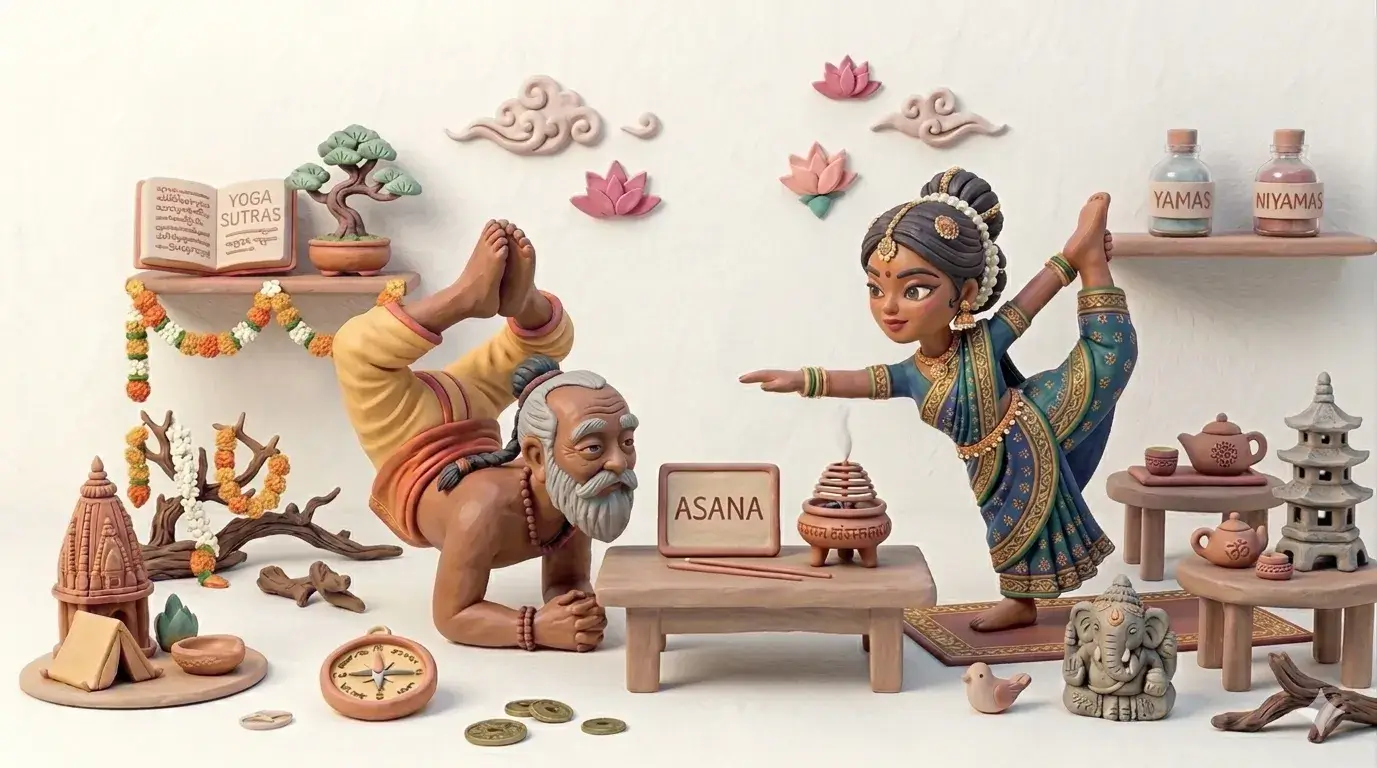
Āsana: More Than a Pose
This is Part 3 of a series on the eight limbs of yoga. Parts 1 and 2 explored the Yamas and Niyamas, the ethical and personal foundations of the yogic path. Now we arrive at the limb most people think they already know: Āsana. Walk into any yoga studio and you'll see it, bodies moving through postures, holding shapes, stretching and strengthening. But Patanjali's definition of Āsana had almost nothing to do with what happens in a modern yoga class. His entire instruction for the physical practice fits into three Sanskrit words: Sthira Sukham Āsanam. Steady. Comfortable. That's it. This article unpacks what that really means, on the mat and far beyond it.
10 min read
·
Mar 31, 2026

The 5 Niyamas in Daily Life
This is Part 2 of a series on the eight limbs of yoga. In Part 1, we explored the five Yamas, the ethical principles that shape how you relate to the world around you. The Niyamas turn that lens inward. They're the second limb of Patanjali's eight-limbed path, and they deal with how you relate to yourself: your habits, your discipline, your inner dialogue, and your willingness to let go. If the Yamas are about how you show up for others, the Niyamas are about how you show up for yourself, especially when nobody's watching.
10 min read
·
Mar 22, 2026

Abundance Consciousness Checklist
You guide your students toward openness, gratitude, and letting go. You cue them to soften, to breathe, to trust the process. But here's a question worth sitting with: do you practise that same abundance off the mat? This checklist isn't a test. It's a mirror. Fifteen honest reflections, and a few Sanskrit breadcrumbs you probably already know by heart.
8 min read
·
Mar 9, 2026